I'm staring at a list of details yet to be taken care of (am I helping organize a wedding or planning for the invasion of Normandy by way of the Texas Hill Country?) and I'm overwhelmed by the odd traditions which have been salvaged, it seems, in the interest of providing additional fiscal stimulus. A cake stand? Rusticated wooden signs? Brunch outfits?
Of course, the to do list being shepherded by The Talented Videographer is an order of magnitude larger (I got a glimpse of it once, and it recalled the scene from Alias where Sidney learns the true extent of SD6's network; The horror, the horror...). On the upside, an additional item for my list is to coordinate the wet bar. I'm going to provide my Yellow Rose (w/ Bowdlerized label) and Slacker beers on tap, as well as an Old Fashioned with smoked Rye Whiskey. In addition, TTV has found her signature cocktail after consultation with Bobby Heugel over at Anvil -- the Lavender Daiquiri:
Texas Lavender Daiquiri
Ingredients: 1½ oz Railean White Rum, ¾ oz Lime Juice, ½ oz Texas Lavender Syrup. Pour ingredients into shaker with ice, shake, and strain into glass. Garnish with lavender sprig.
Lavender Syrup prep
Preparation (Lavender Syrup)
To make lavender syrup combine 2 cups sugar and 2 cups water in a saucepan. Bring syrup to a boil over medium heat and cook for 10 minutes, reducing the water and sugar to a syrup. Add 12 - 14 sprigs of fresh Texas lavender (dried lavender is an acceptable substitute) and allow to boil for 2 minutes. Remove sauce pan from stove and allow syrup to cool at room temperature. When cool strain lavender out and store in the fridge.
Thursday, August 6, 2009
Do weddings have quartermasters?


Wednesday, May 6, 2009
Smoked Rye Whiskey
In the wake of the opening of Anvil last month, and a few more visits to Beavers to chat with Ryan Rouse, I've been experimenting a lot more with Rye. Something they have over at Beaver's is a house-smoked Sazerac Rye (lots easier when you're a barbecue joint). But insofar as I've been cold-smoking stuff lately (bacon, cheeses, cherries), I thought I'd go ahead and smoke some myself. The smoked Old Fashioned I had at Beaver's was *way* too smoky for me, so I aimed to get a little less smoke out of it. And because my wallet's perennially light, I fell back on the good Old Overholt to play around with it. After two batches, smoking with about 2 parts cherry to one part hickory, I think 30 minutes in a 9x12 pan is perfect (the size of the pan matters relative to the volume, because it determines how much surface area is exposed).
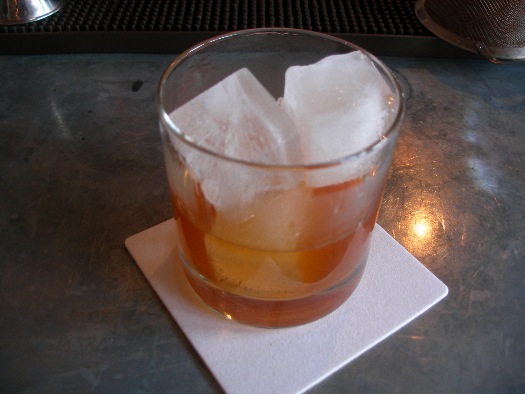
I don't like Old Fashioneds done with muddled fruit; I like a clear cocktail w/o pulp, and usually the sharpness of lemon peel beats out orange. But with the smokiness of the Rye, orange zest is the way to go. Anyway, here's the Old Fashioned I've settled on, and is 95% likely to feature at the wedding in October:
2 oz. smoked Overholt Rye
1/4 oz. simple syrup
4 dashes Fee Brother's Old Fashioned Bitters.
1 Twist of orange zest
2 brandied cherries
Make this in an Old Fashioned glass: pour whiskey over ice, add syrup and bitters, stir for 20 seconds. Twist the orange zest over the cocktail so that the oil spurts out onto the surface, add the cherries, and you're done. Yum.
Saturday, April 14, 2007
A word on mixology


